
The short answer
There is no convincing evidence that creatine monohydrate causes hair loss.
The concern is understandable because one small 2009 study reported an increase in dihydrotestosterone, or DHT, after creatine supplementation. DHT is involved in androgenetic hair loss in people whose follicles are genetically sensitive to it.
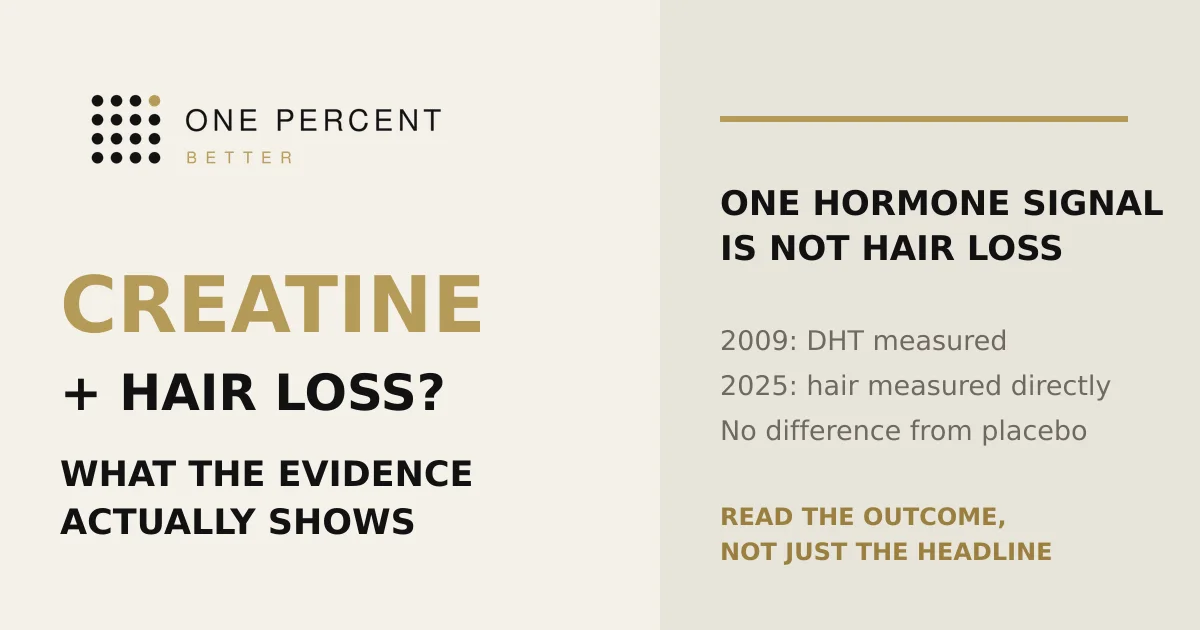
But that study did not measure hair loss. In 2025, a randomised trial directly measured DHT and several hair-follicle outcomes after 12 weeks of creatine. It found no difference from placebo.
Earlier signalA small study found a DHT change but did not measure hair.
Direct evidenceA newer trial measured hair outcomes and found no creatine effect.
Remaining limitOne 12-week hair trial cannot settle every long-term or individual question.
1. Where did the creatine hair-loss claim come from?
Most versions of the claim lead back to one study published in 2009.
Twenty college-aged male rugby players completed a placebo-controlled crossover trial. During the creatine phase, they took 25 g a day for seven days, followed by 5 g a day for another 14 days.
Serum DHT increased after the loading phase and remained above baseline during maintenance. Testosterone did not change.
That result was worth investigating. It was not proof of hair loss. The researchers measured circulating hormones and body composition, not shedding, density, follicle count or hair thickness.
2. Why DHT does not automatically mean balding
DHT matters in androgenetic alopecia, commonly called male or female pattern hair loss. But the relationship is not as simple as more DHT equals immediate hair loss.
Healthdirect explains that androgenetic alopecia is usually genetic. Hormone levels may be normal while susceptible hair follicles are more sensitive to androgen effects.
This distinction matters when reading supplement research. A temporary blood-marker change cannot establish that a supplement caused a visible or lasting change in hair.
It also means an individual noticing shedding should not assume creatine is the cause. Genetics, illness, stress, nutrition, hormonal changes, medicines and scalp conditions can all be relevant.
3. What did the direct hair-loss trial find?
A 2025 randomised, double-blind, placebo-controlled trial recruited 45 resistance-trained men aged 18 to 40. Participants received either 5 g of creatine monohydrate or 5 g of maltodextrin each day for 12 weeks. Thirty-eight completed the study, and one completer had no hair assessment.
The researchers measured total testosterone, free testosterone and DHT. They also used a trichogram and the FotoFinder system to assess hair density, follicular units, growth phase, hair type and cumulative thickness.
Creatine produced no significant difference from placebo in DHT or any measured hair outcome.
This is more directly relevant than the earlier hormone-only study because it tested the outcome people are actually worried about.
4. What remains uncertain?
The newer trial is reassuring, but it is not unlimited evidence.
- It lasted 12 weeks, so it cannot rule out effects that might take longer to appear.
- It studied healthy resistance-trained men, not women or every age and health group.
- It used 5 g daily without a loading phase.
- It did not record family history of hair loss, an important risk factor.
- The sample was modest, so small or uncommon effects could be missed.
The accurate conclusion is not that creatine can never affect anyone's hair. It is that current direct evidence does not support the claim that standard-dose creatine causes hair loss.
5. A practical decision guide
- Do not stop because of the DHT headline aloneThe original study did not measure hair, and the direct trial found no difference from placebo.
- Choose a standard form and doseCreatine monohydrate at 3 to 5 g daily is the usual evidence-based maintenance approach. Loading is optional.
- Track a real change, not a fearIf you are concerned, use consistent photos and avoid changing several products at once.
- Get unexplained hair loss assessedTalk to a GP if shedding is greater than usual, sudden, patchy or occurring in clumps. A clinician can consider other causes.
This is general information, not a diagnosis. Hair loss has many possible causes, and the most useful next step depends on the pattern, timing and your health history.
Facts, claims and what is not confirmed
The 1% Better takeaway
The current evidence is reassuring. A widely repeated claim grew from a small study that measured DHT, not hair loss. The first trial to measure hair directly found no effect from 5 g of creatine monohydrate daily over 12 weeks.
If creatine helps you train and you are not experiencing unexplained hair loss, the evidence does not give a clear reason to stop it for this concern alone. If your hair is changing, investigate the change rather than assuming one supplement caused it.
Compare creatine monohydrate products by testing, certification, ingredient transparency and cost per 5 g.
Sources
Lak et al., 2025 randomised controlled trialA 12-week trial in resistance-trained men compared 5 g creatine monohydrate daily with placebo and directly measured hormones and multiple hair outcomes.Open source ↗van der Merwe et al., 2009 crossover trialA small three-week trial in 20 male rugby players reported higher DHT after creatine loading and maintenance. It measured hormones, not hair loss.Open source ↗Healthdirect Australia, alopeciaHealthdirect explains that hair loss has many possible causes and that androgenetic alopecia is usually genetic, involving follicle sensitivity to androgens.Open source ↗How we reviewed this topic: 1% Better reviewed the published studies and public health guidance linked above. We did not physically test creatine products or collect reader outcomes. Product partnerships do not affect our conclusions, scores or rankings.