
The short answer
Compare protein powders using the cost per equal amount of actual protein.
A bag can be cheaper because it is smaller, contains less protein per 100 g or uses a different serving size. None of those automatically makes it better value.
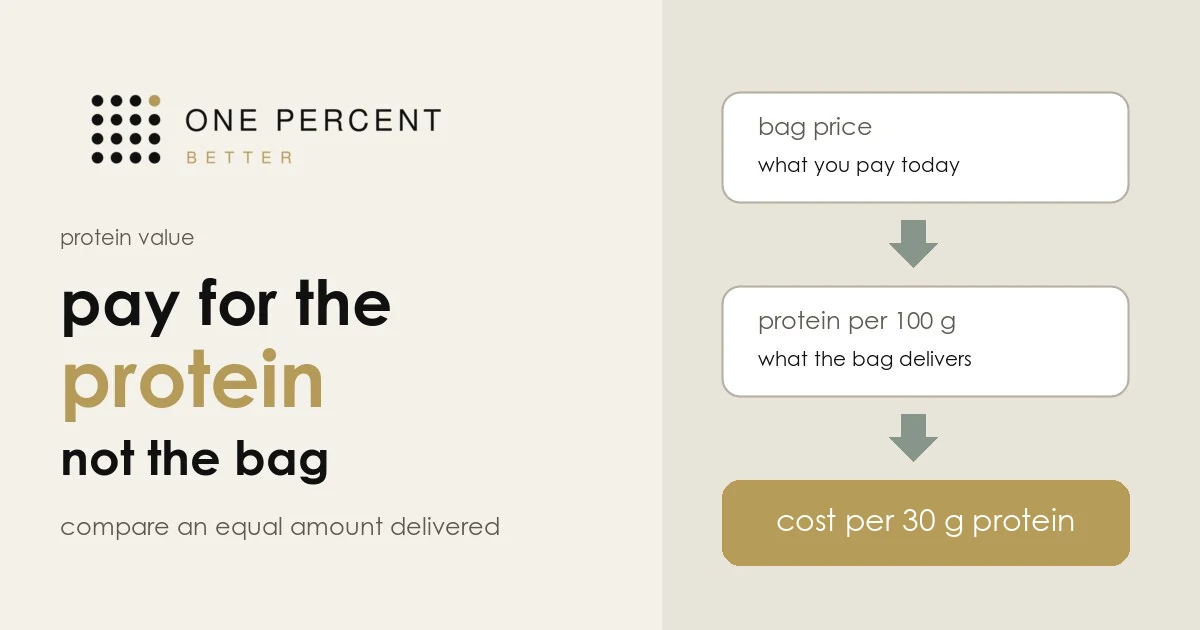
For a practical comparison, calculate the cost per 30 g of protein. This removes the effect of different scoop sizes and protein percentages.
Two different measures: the Protein Index shows the cost per 30 g of powder. This article calculates the cost per 30 g of actual protein. For example, 30 g of an 80% protein powder contains 24 g of protein; you need 37.5 g of that powder to obtain 30 g of protein.
1. Why price per bag can mislead you
A$79 looks cheaper than A$89. But the cheaper bag may also contain less actual protein.
Pack price tells you what you pay at checkout. It does not tell you how much protein the pack delivers.
Price per kilogram is a better first step because it standardises different pack sizes. It still treats every gram of powder as equal, even when one powder is 75 per cent protein and another is 90 per cent.
Bag priceUseful for your immediate budget, but affected by pack size.
Price per kilogramStandardises pack size, but not protein concentration.
Cost per 30 g proteinStandardises both pack size and the actual protein delivered.
2. Why price per serve is not always fair
FSANZ explains that serving sizes are determined by the food business and can vary between products. One brand may call 25 g a serve, while another uses 30 g or 35 g.
That makes price per serve useful for estimating what your usual shake costs. It is not always a like-for-like way to compare products.
Use protein per 100 g to find the protein percentage of the finished powder. FSANZ states that the per 100 g column is designed to compare similar products and that the value works like a percentage.
If the panel lists 80 g protein per 100 g, the powder is approximately 80 per cent protein by weight.
3. Worked example: the A$79 bag versus the A$89 bag
These are illustrative products, not claims about particular brands.
The A$79 bag is A$10 cheaper at checkout. The A$89 bag contains 100 g more protein. Once both are normalised, they cost about A$2.96 and A$2.97 per 30 g of protein.
Neither is automatically the better purchase. The example shows why the shelf price alone cannot settle the value question.
4. Calculate protein powder value in four steps
- Record the regular priceUse the exact pack and flavour. Note a sale separately because promotions change.
- Find protein per 100 gThis is the finished powder's protein percentage and the fair label comparison point.
- Calculate total pack proteinPack weight × protein per 100 g ÷ 100.
- Calculate equal-protein costPrice ÷ total protein grams × 30.
For a 500 g pack at 75 g protein per 100 g, total protein is 375 g. If the pack costs A$45, the calculation is A$45 ÷ 375 × 30 = A$3.60 per 30 g of protein.
5. What the value calculation does not tell you
Cost per 30 g protein is a value measure, not a complete quality score.
It does not establish:
- whether the product suits your dietary needs or allergies
- how you tolerate the sweeteners, gums or lactose
- the amino acid profile or whether the protein is complete
- what the product was tested for or whether testing is current
- whether it has relevant sports certification
- whether you enjoy the taste enough to use it consistently
The AIS also recommends a food-first approach. Protein powder can be convenient, but a low calculated cost does not make a supplement necessary.
Claims, label facts and what to verify
The 1% Better takeaway
A cheaper bag is not always cheaper protein. A cheaper scoop is not always a fair comparison.
Use protein per 100 g, calculate the cost per 30 g of actual protein, then decide whether differences in ingredients, evidence, tolerance and goal-fit are worth paying for.
Use the Protein Index to compare protein density, ingredients, testing evidence and value on the same basis.
Sources
Food Standards Australia New Zealand, nutrition information panelsFSANZ explains that serving sizes are set by the food business and can vary. The per 100 g column is designed to compare similar foods and works like a percentage.Open source ↗Australian Institute of Sport, isolated protein supplementThe AIS describes typical protein ranges for whey concentrate and isolate and notes that a 30 g serve of whey commonly provides about 21 to 27 g of protein.Open source ↗Australian Institute of Sport, concerns and considerationsThe AIS recommends a food-first approach and notes that simple concentrate or isolate products can reduce unnecessary expense when a supplement is useful.Open source ↗How we reviewed this topic: 1% Better reviewed Australian label guidance and public sports-nutrition guidance. The worked prices are illustrative and are not current product claims. We do not physically test products unless explicitly stated. Affiliate relationships do not change rankings, scores or editorial conclusions.