
The short answer
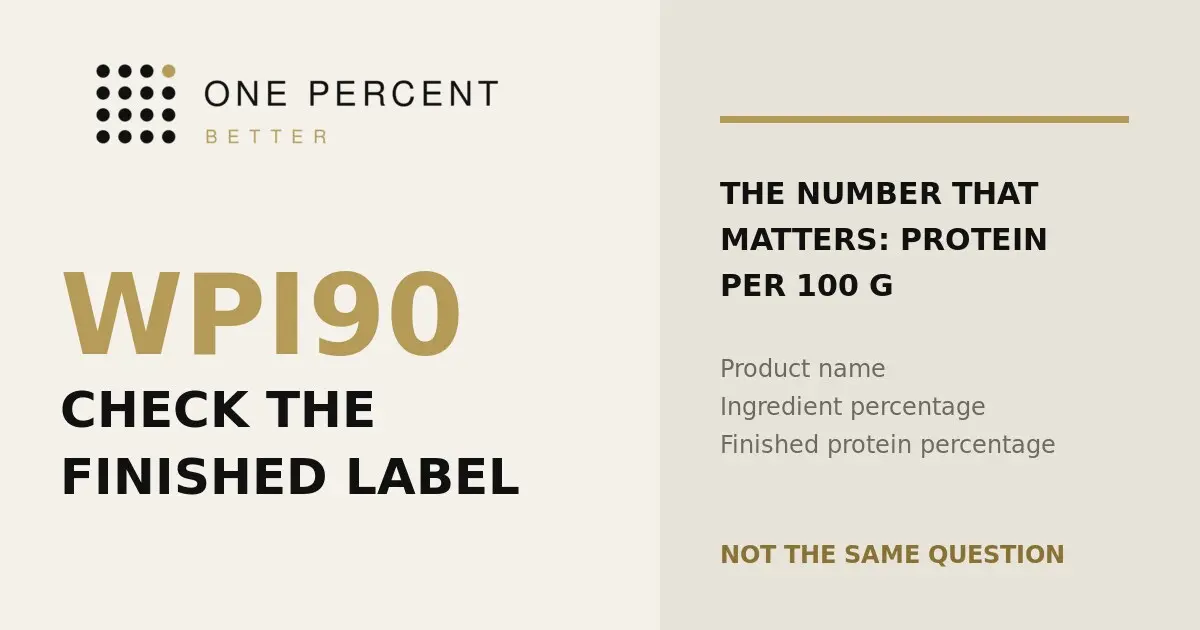
No. WPI90 does not always mean the finished powder is 90 per cent protein.
Whey protein isolate itself is typically around 90 per cent protein by weight. A finished product can also contain flavouring, cocoa, fibre, emulsifiers, sweeteners and other ingredients. Those additions change the protein percentage of the powder in the bag.
For the number you will actually consume, check protein per 100 g in the nutrition information panel. In Australia and New Zealand, that figure works like a percentage.
IngredientWPI90 can identify a high-protein whey isolate ingredient or product range.
Finished powderThe nutrition panel shows the average protein in the complete formula you buy.
Fair comparisonUse protein per 100 g, then compare price per equal amount of actual protein.
1. Separate the ingredient from the finished formula
The Australian Institute of Sport describes WPI as a further-filtered whey product that is typically about 90 per cent protein by weight. That makes 90 a useful shorthand for a common isolate specification.
But a retail protein powder is often a formula, not a bag of the raw ingredient alone.
If whey protein isolate makes up 90 per cent of a flavoured formula, the remaining 10 per cent may include cocoa, flavours, fibre, lecithin, gums or sweetener. The finished powder can therefore contain less than 90 g of protein per 100 g, even when its main ingredient is a WPI90 material.
2. Use the per 100 g protein figure
FSANZ requires nutrition information panels to show average protein per serve and per 100 g. It also explains that serving sizes are set by the food business and may vary between products.
That is why the per 100 g column is the cleaner comparison. If a panel lists 81 g protein per 100 g, the finished powder is approximately 81 per cent protein by weight. If it lists 89 g per 100 g, it is approximately 89 per cent.
Protein per serve is still useful for planning a shake. It just answers a different question.
3. A real example: one range, different protein percentages
True Protein's Australian WPI90 page provides a useful, transparent example. On 30 October 2026, the page listed Rich Chocolate 1 kg with whey protein isolate at 90 per cent of the formula. Its nutrition panel showed 81 g of protein per 100 g of finished powder.
The same page listed the Natural flavour at 89 g protein per 100 g. French Vanilla was 85 g per 100 g. The exact flavour changed the finished protein concentration.
This is not evidence of a quality problem. It is evidence that the product name, ingredient percentage and finished nutrition panel are not interchangeable.
The page also makes the relevant information available. The buyer can see the ingredient list and flavour-specific nutrition values instead of having to infer them from the range name.
4. Compare value using actual protein, not the 90
A higher finished protein percentage means more of each gram of powder is protein. It does not automatically make the product the best choice. Taste, ingredients, tolerance, testing, sports certification and price still matter.
For a fair value calculation, use:
Cost per 25 g of protein = pack price ÷ total grams of protein in the pack × 25
A 1 kg powder at 81 g protein per 100 g contains about 810 g of protein across the pack. A 1 kg powder at 89 g per 100 g contains about 890 g. That difference should be reflected when comparing value, rather than assuming both deliver the same amount because both use WPI.
Use the exact current price, pack size and flavour when doing the calculation. Promotions and product formulas can change.
5. Use this three-check buying rule
- Read the exact flavourNutrition values can differ within the same product range.
- Find protein per 100 gThis is the finished protein percentage and the fair comparison point.
- Calculate equal-protein valueCompare cost per 30 g of actual protein, then weigh formula, testing and tolerance.
If the brand does not publish flavour-specific nutrition information, the finished protein percentage cannot be confirmed from the product name alone. Missing disclosure does not prove the powder is poor quality. It simply limits what can be verified before purchase.
Facts, claims and what remains unconfirmed
The 1% Better takeaway
WPI90 is a useful clue, not the final answer.
Before paying a premium, check the exact flavour's protein per 100 g. Then compare equal-protein cost and the features that matter to you, such as ingredients, testing evidence, certification and tolerance.
Use the Protein Index to compare flavour-specific protein density, ingredients, evidence and value on the same basis.
Sources and evidence notes
Evidence and product information checked on 30 October 2026. Product values can change. One Percent Better reviewed public information and did not physically test the products discussed.
- Australian Institute of Sport, Isolated protein supplementThe AIS describes whey protein isolate as a further-filtered whey product that is typically about 90 per cent protein by weight, with minimal carbohydrate and fat.
- Food Standards Australia New Zealand, Nutrition information panelsFSANZ explains that the per 100 g column is the fair comparison point for similar foods and that the figure is effectively a percentage. Serving sizes are set by the food business and can vary.
- Food Standards Australia New Zealand, Ingredient lists and percentage labellingFSANZ states that ingredients are listed in descending order by ingoing weight and that percentage labelling can identify a key or characterising ingredient.
- True Protein Australia, WPI90 product pageThe Australian product page reviewed on 30 October 2026 listed Rich Chocolate 1 kg with whey protein isolate at 90 per cent of the formula and 81 g protein per 100 g of finished powder. Other flavours on the same page had different protein values.